
Greenwood County Criminal Court Records
A Greenwood County criminal court record begins when a complaint, information, indictment, or citation is filed with a court. The record is then maintained as a court case, with a docket, filings, hearing entries, judge activity, orders, pleas, disposition, sentence, and financial obligations. The Clerk of the District Court is the local office for district court case files, while the County Attorney handles prosecution decisions and diversion questions.
Kansas district courts are general-jurisdiction trial courts. Greenwood County District Court is part of the 13th Judicial District and handles criminal cases filed at the district level. Eureka Municipal Court can handle city ordinance violations and municipal traffic matters. A criminal court record from either route should be read as a case record, not as a jail roster. Custody status belongs with the sheriff or VINELink, while the full case file belongs with the court clerk.
The Greenwood County Attorney's Office is the local prosecution office identified in the research. Its duties include criminal matters, traffic offenses, juvenile crimes, and child-in-need-of-care cases.
The county attorney source is useful for understanding who files or manages prosecution questions, but it is not a substitute for the Clerk of the District Court when the requester needs the court case file.
Search Greenwood County Criminal Records
Criminal case search begins with Kansas CaseSearch for public district court case information. The portal can show case data and, when allowed, documents. If a Greenwood County criminal case is not available through the online search, the local process is to contact the Clerk of the District Court at 620-583-8153 and schedule public terminal use or public file review. The caller should provide the case number when possible.
- Search Kansas CaseSearch by defendant name or known case number.
- Confirm the court is Greenwood County District Court or another correct Kansas court.
- Open the case and read the charge list, docket entries, hearing history, plea, disposition, and sentence fields.
- Use the courthouse public access computer or clerk file-review appointment if documents are not available online.
- Request certified copies from the Clerk of the District Court when a court-authenticated record is needed.
Statewide criminal history and offender tools have different roles. The Kansas Bureau of Investigation is a state criminal justice source, while the KBI registered offender registry is limited to persons required to register for sex, violent, or drug offenses. Neither should be treated as the complete Greenwood County criminal court case file.
KBI tools can add statewide context, but the district court docket remains the source for local filed charges, pleas, orders, disposition, and sentence.
Greenwood County Criminal Case Flow
A Greenwood County criminal court record changes as the case moves through court. The first filed charge may not be the last charge. Motions can alter what the court considers. A diversion agreement can change the path of a case. A plea or verdict can create a conviction, while dismissal or acquittal can end a charge without conviction.
Case flow: Charges Filed › Arraignment › Pretrial / Motions › Plea or Trial › Disposition › Sentencing
| Stage | What Happens |
|---|---|
| Charges Filed | The complaint, information, indictment, or citation opens the criminal court case. |
| Arraignment | The defendant is advised of charges and enters a plea such as guilty, no contest, or not guilty. |
| Pretrial / Motions | The parties file motions, request rulings, address discovery, discuss diversion, or prepare for trial. |
| Plea or Trial | The case resolves through a plea, bench trial, jury trial, dismissal, or other court action. |
| Disposition | The docket records the outcome of each count or the case as a whole. |
| Sentencing | The court imposes jail, prison, probation, fines, costs, restitution, or other lawful conditions after conviction. |
Greenwood Criminal Record Fields
A criminal court record in Greenwood County can include case number, court, filing date, defendant, attorneys, judge, charge names, statute references, severity, bond, warrants or returns, hearing settings, docket entries, motions, diversion, plea, disposition, sentence, probation, fines, costs, restitution, and appeal notices. Some items may be public as case data while documents remain limited by Kansas Rule 22 or case confidentiality.
| Field | What It Shows |
|---|---|
| Case Number | The Kansas court tracking number for the criminal case. |
| Defendant | The person charged in the criminal case. |
| Prosecutor | The County Attorney or other prosecuting authority linked to the case. |
| Defense Counsel | Private attorney, appointed counsel, public defender or assigned counsel, or pro se status. |
| Charges | Offense names, counts, statutes, and severity or class details where public. |
| Plea | Guilty, no contest, not guilty, or other plea event shown in the docket. |
| Disposition | Convicted, dismissed, acquitted, diverted, amended, or other outcome by count or case. |
| Sentence | Jail, prison, probation, fines, costs, restitution, or other court-ordered terms. |
The Kansas State Board of Indigents' Defense Services is relevant when a defendant cannot afford counsel in an adult felony case. Appointment is made by the district court, not by a walk-in local public defender office in Greenwood County.

Defense appointment information can appear in the case record as counsel information, but eligibility and appointment decisions are handled through the court process.
Charges vs Convictions
A charge is an accusation filed in court. A conviction is a final outcome based on a guilty plea, no-contest plea accepted by the court, or a guilty verdict. Greenwood County criminal court records can show both charges that resulted in conviction and charges that were dismissed, amended, reduced, diverted, or resolved without conviction. That is why a docket entry must be read by count and by disposition.
| Point | Charge | Conviction |
|---|---|---|
| Meaning | An alleged offense filed in court | A final finding or accepted plea of guilt |
| Timing | Early in the case | After plea, trial, or other final court action |
| Can change | May be amended, reduced, added, or dismissed | May later be appealed, corrected, or expunged if eligible |
| How to verify | Review the filed charge and docket status | Review disposition and sentencing entries |
The closer look at the arrest-to-charge path belongs on the Greenwood County arrest records and court charges page, while this criminal page focuses on the full court case file and its outcome.
Diversion and Defense Records
The 13th Judicial District Greenwood County Pay a Fine research states that the Greenwood County Attorney's Office has established a pretrial diversion program. Diversion is a prosecutor-supervised agreement that may avoid conviction if completed. A diversion event can appear in the criminal court record, but eligibility questions should go to the County Attorney's Office at the number listed in the research. Diversion is not the same as a dismissal, acquittal, or expungement.
BIDS client instructions say public defenders or assigned counsel can only be appointed by a district court judge in adult felony cases. A defendant submits the application and financial affidavit to the district court in the county where charged, and the court decides qualification. The research did not identify Greenwood County as having a local public defender office. Nearby regional public defender offices exist, but Greenwood County cases should still route appointment requests through Greenwood County District Court.
The BIDS client resources page explains the appointed-counsel route for Kansas criminal defendants.

The resources support the court-record reading point: counsel status is part of the criminal case file, but the judge controls appointment in qualifying cases.
Sealed vs Expunged Records
Greenwood County criminal court records can be restricted by sealing, expungement, juvenile confidentiality, or redaction rules. Expungement under Kansas law can limit public access to eligible convictions, arrest records, and diversion agreements. Sealing closes a record from ordinary public view by law or court order. Redaction removes protected information from a record that may otherwise be released.
| Point | Sealed | Expunged |
|---|---|---|
| Public visibility | Hidden from ordinary public access | Restricted from public view after court process if eligible |
| Record existence | The file still exists under court control | The record may still exist for limited statutory purposes |
| Typical route | Law, court order, or confidential case category | Petition in the court where the case was filed |
| Examples | Juvenile, adoption, mental health, protected data | Eligible convictions, arrest records, and diversion agreements under K.S.A. 21-6614 |
The Kansas appointed counsel statute supports the broader criminal process by authorizing BIDS to provide counsel through appointed counsel, contract counsel, public defender offices, or a combination.
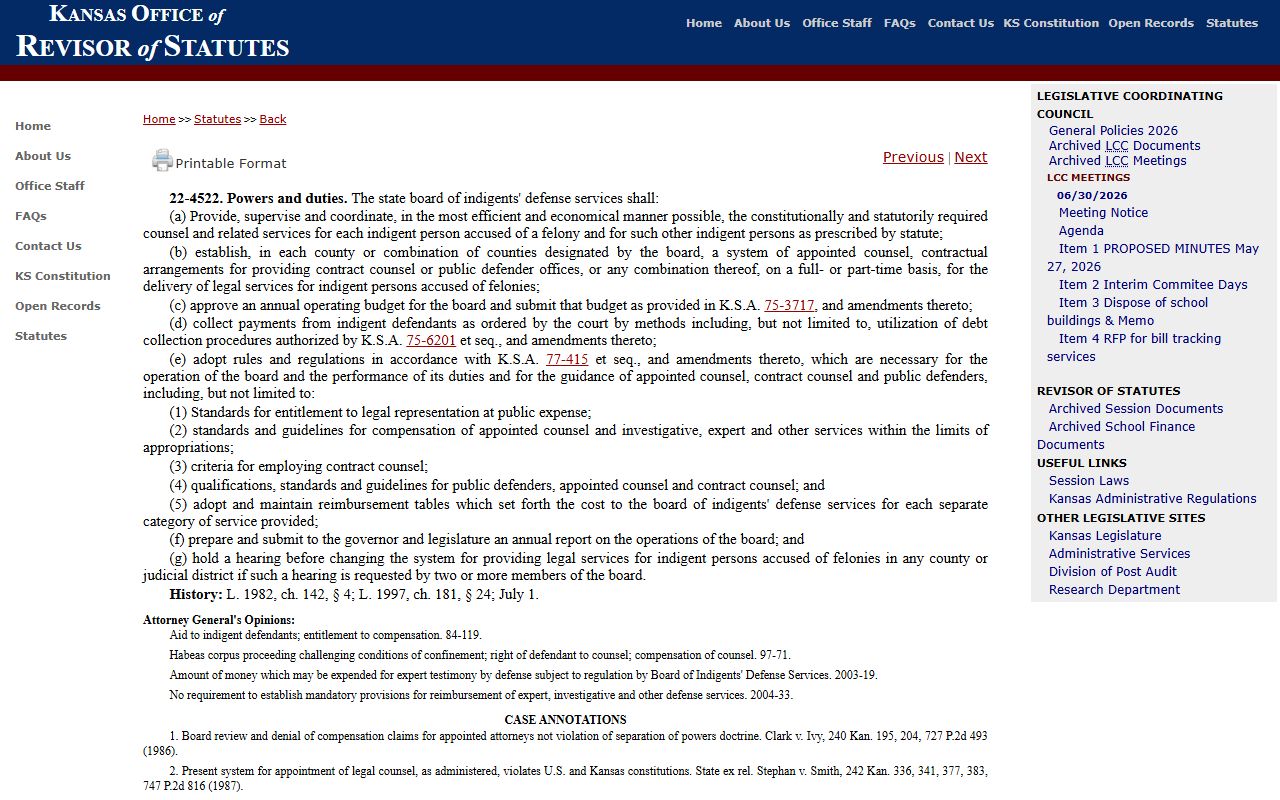
When counsel appointment, plea, sentence, or expungement issues matter, verify the docket and the filed orders with the clerk rather than relying on a short online summary.
Access Greenwood Criminal Records
Public access to Greenwood County criminal court records is broad but not unlimited. Kansas Supreme Court Rule 22 governs public electronic access to district and appellate case records. The Kansas Open Records Act provides the public-records framework for existing public records, but the research file emphasizes that court records are handled through the state court office, not the County Clerk's county-government request process.
Juvenile cases require special care. Kansas juvenile court records, law-enforcement juvenile records, diagnostic records, treatment records, and medical information have special restrictions under K.S.A. 38-2309 through 38-2312. A juvenile charge should not be treated like an ordinary adult public criminal case. Social Security numbers, account data, minor identities, protected addresses, victim details, and medical information may also be redacted.
The BIDS forms page includes forms that can relate to appointed-counsel requests in Kansas cases.
Forms can support a defendant's court process, but public access to the resulting criminal case record remains controlled by the court and Kansas access rules.
Important: Online criminal court records should be verified with the clerk before use in legal, employment, housing, or licensing decisions.