
Greenwood County Probate Records
Probate matters in Greenwood County are filed in the Greenwood County District Court, not in a separate county probate court. Kansas district courts have general trial jurisdiction, and the local probate venue is the Probate Division of District Court. That means estate and guardianship files use the same courthouse address, clerk counter, public access computer, and written request path used for other district court files in Eureka.
The records can include wills, petitions to admit a will, petitions for administration, notices to creditors, inventories, fiduciary appointments, accountings, claims, receipts, orders, and final settlement or distribution papers. Guardianship and conservatorship files may include petitions, reports, accountings, and orders about a protected person or protected property. Some material may be open, while other details can be sealed, redacted, or limited because minors, medical facts, finances, or protected persons are involved.
Probate files often connect to other records. When a Greenwood County estate includes land, the Register of Deeds may have deeds, mortgages, oil and gas leases, tax liens, or other recorded instruments tied to the property. The Register of Deeds has public workstations for records from 2003 to present and numerical indexes from 1858 to present. Those land records help trace ownership, but the court file remains the source for probate orders and fiduciary authority.
Older probate research can require both paths. A court file may explain who had authority to act for an estate, while a deed index may show what happened to land after that authority was granted. The research did not locate a separate historical probate database for Greenwood County, so older estate work should start with the case number if one is known, then move through the courthouse appointment process and related Register of Deeds indexes when real property is involved.
Greenwood County Probate Terms
Probate records use short legal terms that can change what a file means. A person searching Greenwood County estate records should read the docket terms before treating a filing as a final court order. A petition asks for action, while an order shows what the judge approved. A fiduciary title also matters because an executor, administrator, guardian, and conservator have different roles.
- Testator
- A person who made a will before death.
- Executor
- The person named in a will to carry out the will after the court grants authority.
- Intestate
- A death without a valid will, so estate distribution follows Kansas law and court orders.
- Guardianship
- A court case about personal care and decision-making for a minor or adult who needs legal protection.
- Conservatorship
- A court case about managing money or property for a protected person.
Search Greenwood County Probate Files
The best probate search path follows the district court access chain documented by the 13th Judicial District. Start with Kansas CaseSearch when the estate name, party name, or case number is known. If the probate record is not visible online, contact the Greenwood County Court Clerk to schedule public access computer time or a file-review appointment. The district court page asks requesters to provide the case number when making an appointment, so any number found online or in family papers should be saved.
- Search Kansas CaseSearch by estate, party, or case number if known.
- Write down the case number, filing year, decedent or protected person name, and document needed.
- Call the Clerk of the District Court at 620-583-8153 to schedule terminal use or file review.
- Use a written request when copies, certified documents, authentication, email copies, fax copies, or hearing recordings are needed.
- Check the Register of Deeds when the probate question involves land title, deeds, liens, or oil and gas instruments.
The 13th Judicial District Greenwood County page says court files open to the public may be accessed by appointment and that a separate public access computer is available outside court offices by scheduled time. It also says written court record requests receive a three-business-day response. That response may provide the record, explain inspection, acknowledge receipt with time and cost, or explain why the requested material cannot be provided.
Greenwood County Probate Court Contact
Greenwood County has one district court location for probate filings. Probate case questions, copy requests, public terminal appointments, and file-review scheduling should go to the Clerk of the District Court. County-government KORA requests go to the County Clerk, but court case files are state judicial branch records even though both offices are in the courthouse.
Probate Division of District Court
Clerk: Erin Meador, Clerk of the District Court
311 N Main
Eureka, KS 67045
620-583-8153
Fax: 620-583-6818
Monday-Friday, 8 am-noon and 1-5 pm; closed Thursdays 1:30-2:30 pm
Register of Deeds
311 N Main St
Eureka, KS 67045
620-583-8162
Fax: 620-583-8178
deeds@greenwoodcounty.org
Greenwood County Probate Fees
A Greenwood County probate filing fee schedule was not located in the accessible official research materials. For record copies from an existing probate case, the local district court copy and research fees apply. The Kansas Judicial Branch has statewide record fee rules, but the local 13th Judicial District page publishes Greenwood-specific minimums for copy work, certification, authentication, research, and recorded hearing copies.
| Probate record item | Amount / rule |
|---|---|
| Paper copy | Minimum $0.50 per page |
| Fax copy | Minimum $1.00 per page |
| Email copy | No cost if less than one hour of research or compilation |
| Certification | Minimum $1.00 per certified document |
| Authentication packet | Minimum $3.00 per packet |
| Research and compilation | Minimum $12.00 per hour |
| Recorded hearing copy | $50.00 per hearing up to one day |
Fee estimates matter when a probate request is broad. A request for an entire estate file may take staff time, while a request for one certified order can be more direct. If a copy must be used in a land transfer, bank matter, or other formal setting, ask whether a certified copy or authenticated packet is required before paying for plain copies.
Small Estate Probate Options
Kansas Judicial Council materials include a small estate affidavit under K.S.A. 59-1507b. The research notes that this process can be used for certain personal property transfers in place of a probate proceeding for estates under $75,000. It is not a court order appointing an executor or administrator, and it does not solve every estate issue.
Use care when an estate includes real estate, unknown heirs, creditor disputes, contested wills, or property that a third party will not release on an affidavit. In those cases, a Greenwood County probate case may still be needed. Related land transfers may also require deeds or other recorded instruments after the proper authority exists. The Kansas Judicial Council legal forms page is the official source for free noncommercial forms located in the research file.
Kansas probate law appears in Chapter 59 of the Kansas statutes. The statute index is useful for confirming the governing chapter, but the case-specific record is still held by the district court clerk when a probate case has been opened in Greenwood County.
Greenwood County Probate Law Source
The Kansas probate code chapter index is the statute source that frames local estate, guardianship, and conservatorship filings.
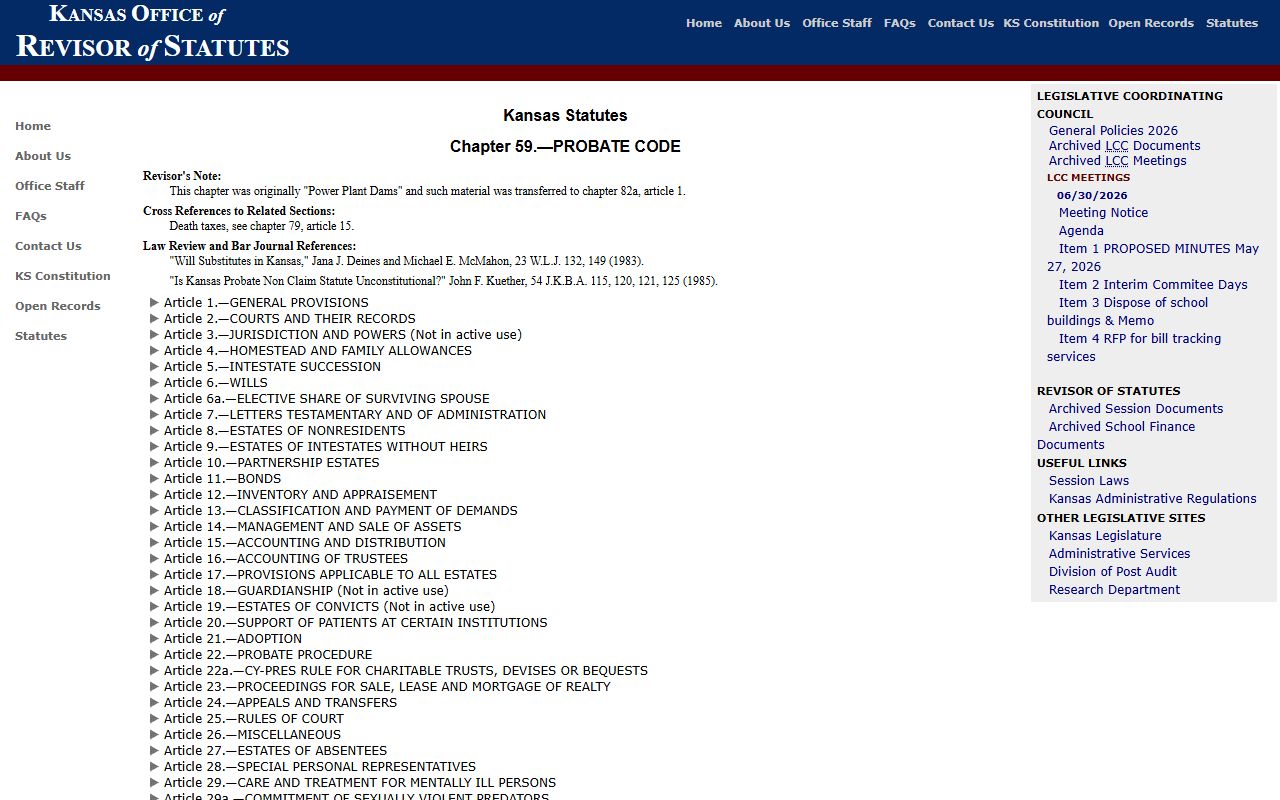
That state law source helps explain why Greenwood County probate files are district court records, while the local clerk process controls how the public asks to inspect or copy a specific case file.
Restricted Greenwood County Probate Records
Not every probate-related file is fully public. Guardianship and conservatorship cases may contain medical, financial, minor, or protected-person details. The public portion of a case may be available while sensitive material is sealed or redacted. Court staff may also limit access when a law or court order restricts a document, even if other docket entries remain viewable.
Redaction means closed details are removed or obscured while the open parts of a record are released. Sealing means ordinary public access is blocked by law or order. A probate search should distinguish between a missing online result and a restricted record. Some records are not online because of eCourt timing or document access limits; other records are unavailable because the law protects the content.
Copy requests should be narrow when possible. A request for a named order, will, inventory, or final settlement is easier for staff to price than a request for every document in a decades-old estate. If the requester does not know the case number, useful identifiers include the decedent or protected person's full name, approximate year, family names that may appear as petitioners, and whether land in Greenwood County was part of the matter.
Note: For court case files, contact the Clerk of the District Court rather than filing a county-government KORA request with the County Clerk.